



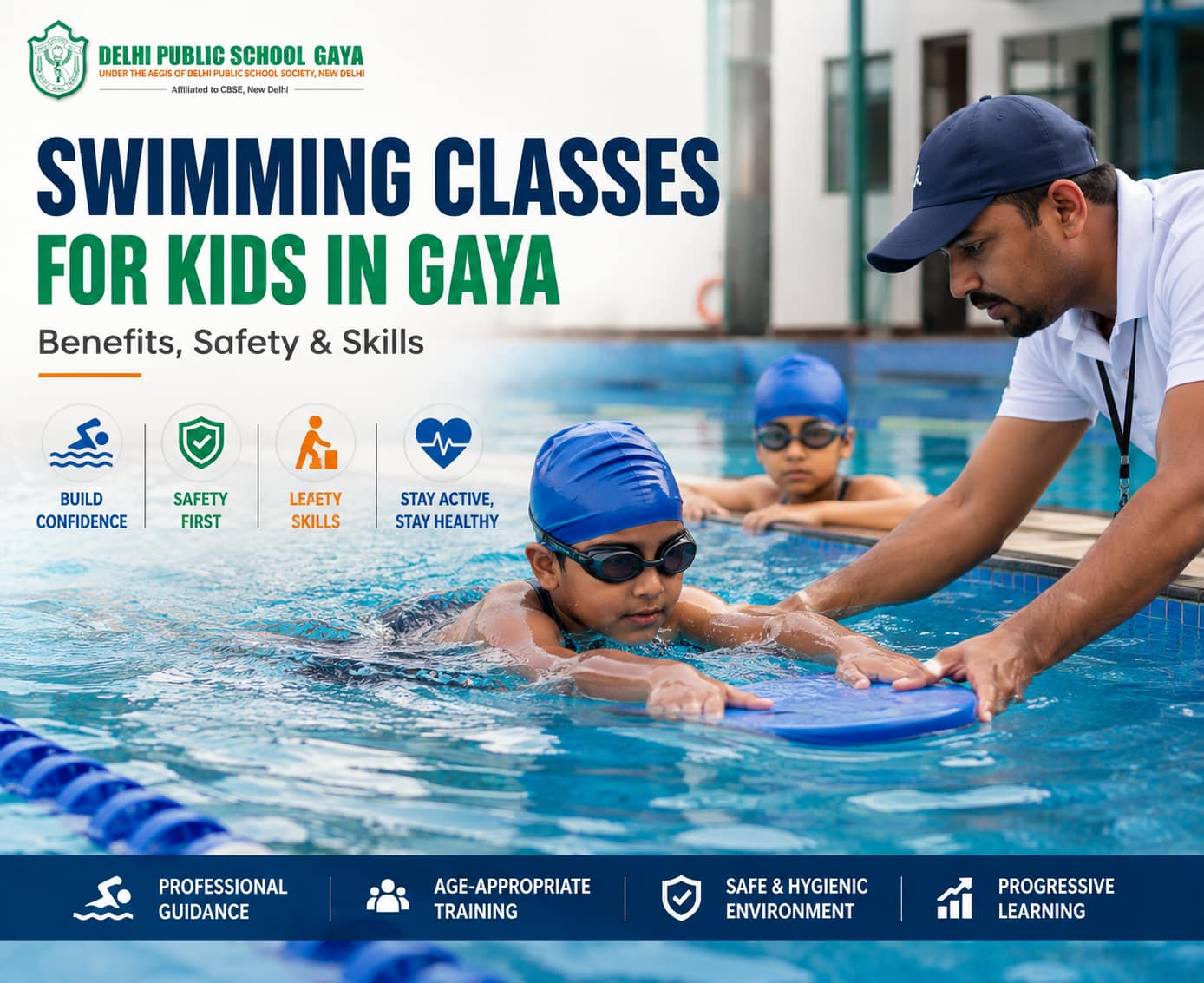
Swimming Classes for Kids in Gaya: Benefits, Safety & Skills
DPS Gaya Team
Verified Author
Parents in Gaya usually start looking at swimming for one of two reasons. Either their child is nervous around water, or they want a sport that fits a busy school week. Both are good reasons to begin.
Before comparing swimming classes in Gaya, it helps to know what actually matters. Age readiness, instructor supervision, group size and safety practice affect a child's progress far more than the length of a course or the price of a package.
This guide covers when children can begin, what beginners learn first, why water safety comes before stroke technique, and what to check before enrolling. It also looks at why access to sport is worth weighing when you evaluate a school.
Why Is Swimming an Important Life Skill for Children?
Swimming is a life skill because it teaches a child to stay calm, breathe and move in water, a situation they cannot fully control. Unlike most sports, the skill has a safety purpose. A child who is comfortable and capable in water is better prepared around pools and open water.
Water confidence is the base of that skill. It means a child can enter the water, put their face in, breathe out below the surface and return to standing or floating without panic. Everything else is built on top of it.
Bihar has plenty of open water, and ponds and river banks attract children during the hot months. Curiosity does not wait for training. A supervised pool is a far better place to build that ability than learning by accident.
Swimming also builds independence early. A child who follows pool rules and finishes a session without constant prompting carries that habit into school life.
What Is the Right Age for Kids to Start Swimming Classes?
Most children are ready for structured swimming lessons somewhere between four and six years of age, once they can follow simple instructions and stay comfortable in a small group. Younger children can begin water familiarisation with an adult in the water. Readiness depends on the individual child, not the birth date alone.
Consider these factors rather than age on its own:
• Comfort around water. A child who cries at bath-time water on the face needs a slower, gentler start.
• Attention span. Group lessons need a child who can listen and wait for a turn.
• Physical readiness. Kicking, gripping the wall and holding a float need basic gross motor control.
• Supervision available. Beginners need close instructor attention, especially in the first few weeks.
• Quality of teaching. A patient instructor can start a hesitant child at an age when a rushed one cannot.
Starting later is not a disadvantage. Children of eight, ten or twelve often learn faster because they understand corrections and can adjust their own movement. A child pushed before they are ready usually takes longer overall.
As a rough guide, this is what different age groups are typically working on. Individual children vary widely, and a good instructor will place a child by ability rather than by age.
Age band | Usually working on | What parents should expect |
2-4 years | Water familiarisation with an adult in the water | Play-led sessions, no formal strokes, progress measured in comfort |
4-6 years | Breathing control, supported floats, first kicks | Short sessions, high supervision, slow and uneven progress |
6-9 years | Independent floating, gliding, freestyle basics | Visible milestones, first real stamina gains |
9-12 years | Stroke refinement, backstroke and breaststroke, endurance | Faster technical progress, capacity for structured training |
12+ years (beginner) | Compressed version of all of the above | Often the quickest learners, since instructions land immediately |
Key Benefits of Swimming for School-Age Children
Swimming works the whole body while the water supports the joints. That combination suits children across a wide range of fitness levels.
Physical Fitness
Continuous swimming is a steady cardiovascular activity. Regular sessions can support stamina and endurance, while water resistance builds strength through the shoulders, back, core and legs, and a full stroke encourages flexibility. Because water supports the body, there is less impact on growing joints than in running-based sports.
Coordination and Motor Skills
Swimming asks a child to move arms and legs in different patterns while timing a breath. That is demanding for young learners, and it develops gross motor skills, bilateral coordination and body awareness. Balance in water differs from balance on land, so children learn to control position from the core rather than the feet.
Confidence and Independence
Progress in swimming is visible. A child who could not float last month can float this month. Those provable milestones help a hesitant child see themselves as someone who improves with effort, which is often worth more than the skill itself.
Discipline and Focus
Lessons run on a fixed schedule and follow a sequence. Children learn to arrive prepared, take one correction at a time and repeat a movement until it settles. That habit transfers to homework and revision more often than parents expect.
Emotional Wellbeing
Physical activity can form part of a healthy routine, and many children are calmer on days they have been active. Swimming can contribute to that. It is not a treatment for any condition, and specific concerns about a child's health should go to a qualified doctor.
Why Should Water Safety Come Before Swimming Technique?
Water safety comes first because a child can be at risk while they are still learning to swim. Before strokes, children need to know pool rules, how to enter and exit safely, how to reach the wall or the side, and when to signal for help. Technique improves performance. Safety habits protect the child while that technique develops.
A good beginner class treats safety as part of the lesson, not a briefing at the start of term:
• Constant adult supervision with eyes on the water, not on a phone or a clipboard.
• A trained instructor or coach who knows how to handle a panicked beginner.
• Clear pool rules on running, diving, depth limits and where beginners may go.
• Controlled entry and exit so children learn to use steps and the wall properly.
• Familiarity before challenge, so a child is never moved to deeper water before they are steady in shallow water.
• Simple emergency awareness, such as knowing how to call an adult and never entering water alone.
One point is worth stating plainly to every parent: swimming ability does not replace appropriate adult supervision and water-safety practices. A child who swims well can still get into difficulty in an unfamiliar pool, in a current, or when tired. Supervision remains necessary at every stage.
At a school, pool safety usually sits inside a wider system. DPS Gaya publishes its campus safety and supervision measures and its on-campus medical support, and those are the kind of details worth asking any institution to show you.
What Should Parents Look for in Swimming Classes in Gaya?
Use this checklist when you visit or enquire about swimming classes in Gaya. These are general criteria and apply to any programme, whether at a school, a club or a private facility.
1. Supervision ratio. How many beginners per instructor, and is anyone watching the water separately?
2. Instructor training. Ask what training the coaches have and how they handle a frightened child.
3. Learner area. Is there shallow or dedicated learner water, or are beginners put straight into a full-depth pool?
4. Structured progression. Can they explain what a child learns in week one, four and twelve?
5. Age-appropriate grouping. Small children should not be taught in the same group as teenagers.
6. Session length and frequency. Short, regular sessions beat long, occasional ones.
7. Water and area cleanliness. Check water clarity, the deck, the changing rooms and toilets.
8. Safety equipment. Floats, kickboards and rescue equipment should be present and in usable condition.
9. Comfort for your child. Separate changing arrangements matter, especially for girls and older children.
10. Communication. Will you be told how your child is progressing, or only at the end of the course?
If a programme cannot answer the supervision and progression questions clearly, that is a signal, however good the facility looks.
What Do Beginners Usually Learn in Swimming Lessons?
Beginner lessons follow a standard order, and the sequence matters because each step depends on the one before it.
1. Water familiarisation. Entering, walking, splashing and getting the face wet without stress.
2. Breathing control. Blowing bubbles out through the mouth and nose, then rhythmic breathing.
3. Floating. Front and back floats, usually with support first, then without.
4. Body position. Learning to stay flat and streamlined instead of sitting upright in the water.
5. Kicking. Flutter kicks from the hip, first at the wall, then with a kickboard.
6. Basic movement. Gliding, combining a push-off with a float and kick.
7. Introductory strokes. Once the above are steady, most learners start freestyle, then backstroke, with breaststroke taught later because the timing is harder.
Children also pick up routine alongside the skills: fitting a cap and goggles, showering before entering, and packing their own kit afterwards.
How Can Swimming Support a Child's Overall Development?
The benefits above appear within weeks. The developmental value shows up over terms and years, and comes from the shape of the activity rather than the exercise.
Swimming is honest. A child cannot bluff a float or fake a length. When progress stalls, and it always does, they have to keep attending and keep working on one small correction. Sitting with a plateau instead of quitting is a resilience that is hard to teach directly.
It also hands responsibility to the child. Remembering your kit, drying it and being ready on time is a weekly routine the parent should not be running.
Within a school, swimming fits naturally into physical education and the sports curriculum. A child who trains with a group and takes part in events learns to manage a commitment alongside academics. That balance is the real long-term outcome, more than any single stroke.
Why Should Parents Consider Sports Opportunities When Choosing a School?
For most families, a school decision is about academics first. Sport still matters, because it decides how much physical activity your child gets on an ordinary weekday.
Practical questions to ask any school you are considering:
• Is physical activity timetabled, or is it optional and easily cancelled?
• Are facilities available to all students, or mainly to selected teams?
• Are trained coaches present, or does a subject teacher supervise?
• How is safety handled at facilities like a pool or a gym?
• Are there regular events where ordinary students participate, not only representative players?
A school's published range of sports and sports facilities will answer several of these before you visit. There is also a simple logistics point. In Gaya, separate coaching after school means travel, waiting time and a later dinner. When the activity happens on campus during the school day, that cost disappears and attendance tends to be far more consistent.
Swimming and Sports at DPS Gaya
Delhi Public School Gaya is a CBSE-affiliated, co-educational school at Dubhal, Gaya, Bihar 823001, run under the Delhi Public School Society, New Delhi.
According to the school's official website, DPS Gaya has a half-Olympic sized swimming pool with a separate toddler pool for Junior School children. Students are allocated specific time slots for swimming, including weekend sessions, and sessions are supervised by trained coaches. The site also lists lifeguards and instructors at the pool, while the school's published safety information notes separate female instructors for girl students and separate changing rooms.
Swimming sits within a wider sports setup that the site lists as including outdoor grounds, basketball courts, a multipurpose sports complex and indoor recreation areas. For current details on the pool and its arrangements, refer to the swimming facilities at DPS Gaya page, or the campus overview for the wider picture.
Parents evaluating schools in Gaya can also look at how academics, physical education and practical life skills fit together in the overall environment. The admission procedure page has details for families considering a visit, and questions about specific arrangements are best put to the school through its contact page.
Conclusion: The Decision, in Short
Swimming earns its place in a child's week because it is a skill they keep for life, not only a way to stay fit. When comparing options, weigh supervision, instructor training and structured progression above facility appearance or course length. Ask how a programme teaches safety, not just strokes.
Start when your child shows readiness rather than at a fixed age, and give it time before judging results. If you are also choosing a school, check whether physical activity is built into the timetable or left to chance. That single answer tells you a lot about the years ahead.
Frequently Asked Questions
Most children are ready for structured lessons between four and six years, once they can follow instructions and stay settled in a group. Younger children can start water familiarisation with an adult in the water. Older beginners often learn quickly because they understand corrections better. Readiness matters more than a fixed age.
Swimming can support stamina, strength, flexibility and coordination while placing less impact on growing joints than running-based sports. It also builds visible, step-by-step confidence, and the fixed lesson routine encourages discipline. It is a fitness activity and a safety skill at the same time, which few other sports offer.
Beginner classes can be safe when supervision is close, the instructor is trained, and learners start in shallow or dedicated learner water. Ask about the number of children per instructor and whether someone watches the water separately. Swimming ability does not replace adult supervision at any stage of learning.
Check supervision ratios, instructor training, whether there is a learner area, and whether the programme can explain its week-by-week progression. Also look at water and changing-room cleanliness, safety equipment, age-appropriate grouping and how progress is communicated to you. Clear answers to these questions matter more than facility appearance.
There is no fixed timeline. Some children float and glide within a few weeks, while others need a full season to become comfortable putting their face in the water. Attendance consistency, instructor quality and the child's initial comfort in water all affect the pace. Avoid programmes that promise guaranteed results.
A swim cap, well-fitting goggles, swimwear, a towel, slippers, a change of clothes and drinking water cover most sessions. A separate waterproof bag for wet items is useful. Teaching a child to pack and unpack this kit themselves builds a small but real habit of personal responsibility.
Details are published on the swimming facility page of the DPS Gaya website. For current timings, arrangements and any queries specific to your child, parents should contact the school directly through its official contact page.
Get in Touch
Still have questions? Fill out the form below and our team will get back to you shortly.