



Why CBSE Schools Are Focusing More on Skill-Based Learning
DPS Gaya Team
Verified Author
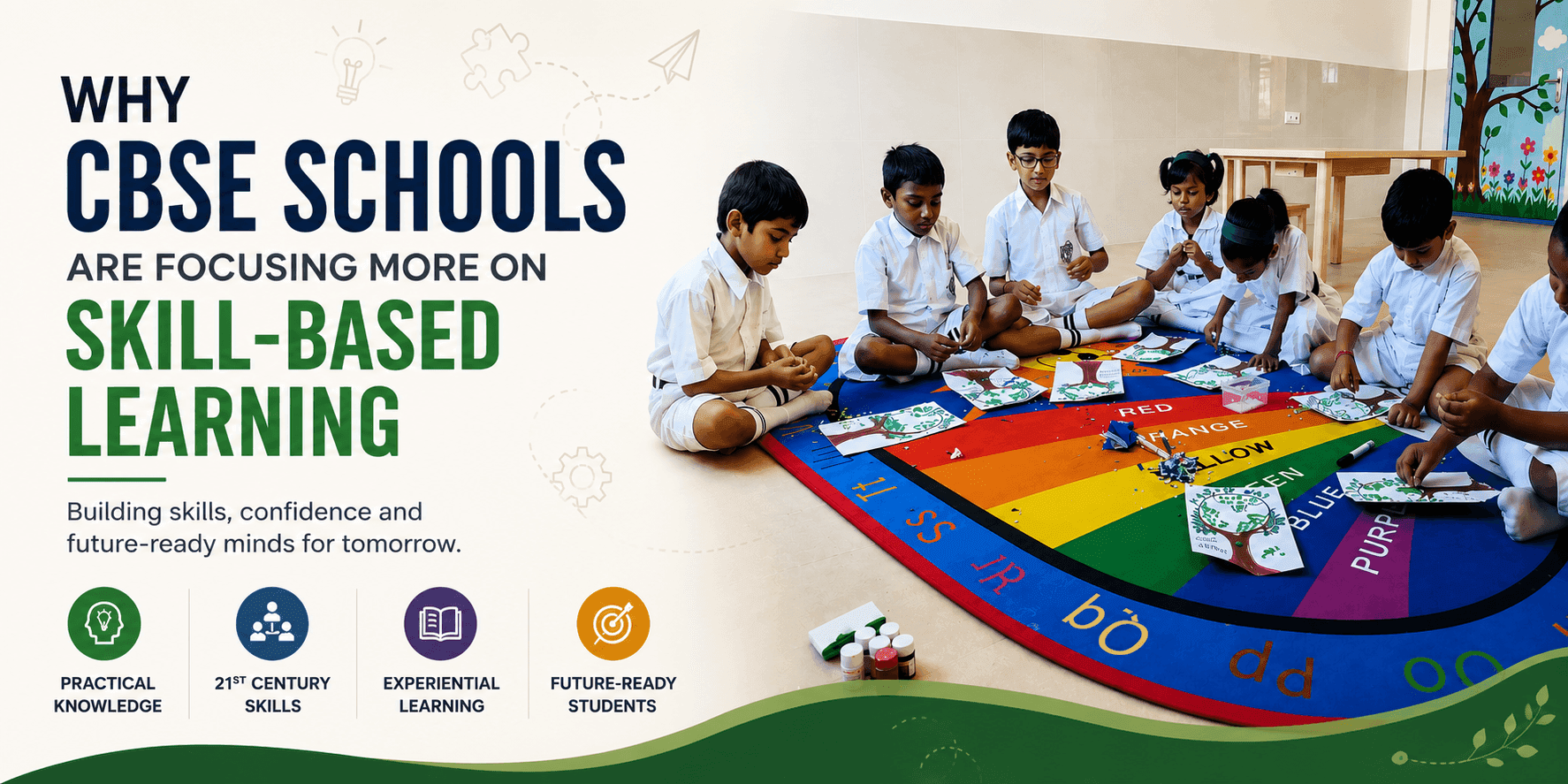
For generations, success in Indian schools was measured by one thing: marks. Students memorised chapters, reproduced them in exams, and moved on. The system worked — until the world outside the classroom changed faster than the curriculum inside it. Today, CBSE schools across the country are making a deliberate shift away from rote learning toward skill-based learning, a model that equips students not just to pass exams, but to navigate real life. This change is not incidental. It reflects a growing recognition that education must prepare students for challenges that textbooks alone cannot anticipate.
At Delhi Public School Gaya, this philosophy is not new — it has been at the heart of how learning is designed, delivered, and experienced every day.
What Is Skill-Based Learning in CBSE Schools?
Skill-based learning is an educational approach that prioritises understanding, application, and problem-solving over memorisation. Instead of asking students to recall information, it asks them to use it — to analyse, create, collaborate, and reflect.
In CBSE schools, this translates into classroom activities where students are encouraged to question, experiment, and connect concepts to real-world situations. A science lesson is not just about learning Newton's laws; it is about understanding why a seatbelt saves lives. A language class is not just about grammar; it is about expressing ideas with clarity and confidence.
This approach aligns directly with CBSE competency-based learning, a framework that defines what students should be able to do with their knowledge, not merely what they should know. DPS Gaya's comprehensive curriculum is built on exactly this foundation — integrating academic rigour with practical application at every stage.
Why CBSE Is Moving Towards Skill-Based Education
Several forces are driving this transformation.
The nature of work and learning has changed. Jobs that existed a decade ago are being automated; jobs that will exist a decade from now do not yet have names. Students entering school today will graduate into a world that demands flexibility, creativity, and the ability to learn continuously. Academic knowledge alone cannot prepare them for that reality.
There is also a growing recognition that practical knowledge matters. Understanding a concept deeply enough to apply it — in a science experiment, a business simulation, or a community project — builds a different kind of competence than understanding it well enough to answer a question on paper.
Most significantly, NEP 2020 skill-based education has given this shift a formal mandate. The National Education Policy 2020 places holistic development at the centre of its vision, calling for competency-based assessments, vocational exposure from early grades, and a curriculum that integrates life skills alongside academic subjects. CBSE has responded by aligning its frameworks, assessments, and guidelines with these priorities — and DPS Gaya's academic overview reflects this alignment in full.
Key Skills Students Develop Through Skill-Based Learning
Skill-based education builds a portfolio of capabilities that serve students across every stage of life.
Critical thinking teaches students to evaluate information, question assumptions, and form reasoned judgements — skills essential for academic research and everyday decision-making alike. This connects directly to how DPS Gaya helps students build problem-solving skills from their earliest years.
Communication skills develop the ability to articulate ideas clearly, listen actively, and engage meaningfully with others, whether in a classroom discussion or a professional setting.
Creativity encourages students to approach problems from unexpected angles, make connections across subjects, and generate original ideas rather than simply replicate existing ones.
Collaboration trains students to work effectively within teams — to share responsibilities, negotiate differences, and build on each other's strengths. Many of the co-curricular activities at DPS Gaya are specifically designed to develop this skill in students.
Digital literacy prepares students for a world in which technology is not optional. DPS Gaya's dedicated Information Technology facility and Robotics & Innovation Lab ensure that students develop this literacy hands-on, not just in theory.
Problem-solving develops the capacity to break down complex challenges, identify root causes, and devise practical solutions — a skill that applies equally to a maths problem and a real-world dilemma.
Leadership and life skills encompass self-awareness, emotional regulation, resilience, and the ability to motivate others — qualities that determine how well a person performs under pressure and how effectively they build relationships.
Role of Practical Learning in the CBSE Curriculum
Practical, experiential learning is the mechanism through which skill-based education comes to life inside classrooms.
Activity-based learning replaces passive listening with active participation. Students conduct experiments, build models, map ideas, and engage with material through doing rather than observing. DPS Gaya's teaching methodology is designed around precisely this principle — ensuring that every lesson has an active dimension.
Projects and assignments connect academic content to real-world contexts. A geography project on local water sources, for example, integrates research skills, environmental awareness, and data presentation — all through a single task.
Real-life examples in teaching make abstract concepts tangible. The school's smart classrooms bring interactive content, simulations, and visual tools into daily learning, making it easy for teachers to ground abstract ideas in concrete reality.
Experiential learning extends further through field visits, inter-house competitions, and cross-curricular projects. DPS Gaya's well-stocked library also plays a vital role — giving students independent access to knowledge and encouraging self-directed learning alongside structured classroom time.
How Skill-Based Learning Benefits Students
The benefits of this approach extend well beyond academic performance.
It improves confidence. When students succeed at a real task — presenting a project, solving a practical problem, or leading a team discussion — they build a sense of capability that marks alone cannot provide. Research on how school environments shape confidence consistently shows that experiential learning is one of the strongest contributors to self-belief in young learners.
It builds deeper understanding. Applying knowledge requires understanding it, not just remembering it. Students who learn through doing are more likely to retain concepts and transfer them to new situations.
It reduces exam stress. When learning is an ongoing process of engagement and application rather than a single high-stakes performance, assessment feels less threatening. Students who understand their material are less dependent on last-minute revision.
It encourages independent thinking. Skill-based classrooms ask students to form their own opinions, design their own approaches, and evaluate their own work. This independence is precisely what higher education and professional environments demand.
It prepares students for life beyond school. Whether a student pursues engineering, arts, entrepreneurship, or social work, the skills developed through this approach — thinking clearly, communicating well, working with others, adapting to new challenges — travel with them everywhere. This is also why DPS Gaya offers early career guidance to help students connect today's skills with tomorrow's possibilities.
Link Between Skill-Based Learning and NEP 2020
NEP 2020 is the most comprehensive reform of India's education system in decades, and its vision is closely aligned with the principles of skill-based learning.
The policy emphasises holistic education — developing the intellectual, emotional, social, and physical dimensions of every student, not only the academic. This means extracurriculars, arts, sports, and community engagement are treated as integral to education, not supplementary to it. At DPS Gaya, this is reflected in a robust sports curriculum and wide range of sports that run alongside academics throughout the year.
Vocational exposure from Grade 6 onward introduces students to practical trades and professional environments early, normalising the idea that skills and knowledge are inseparable.
Competency-based assessment, championed by NEP 2020 and implemented through CBSE, evaluates what students can do with what they know. This shift in how learning is measured changes how it is taught — encouraging teachers to design experiences that build competence, not just content coverage. DPS Gaya's investment in teacher training programmes ensures that faculty are equipped to deliver this kind of learning consistently.
Life skills education has also expanded, with explicit attention to emotional intelligence, civic responsibility, financial literacy, and wellbeing. DPS Gaya's work on building social and emotional skills in the classroom is a direct expression of this priority.
How CBSE Schools Are Implementing Skill-Based Learning
Schools across the country are translating these principles into practice in a variety of ways.
Project-based assignments replace traditional essays and chapter summaries with open-ended challenges. Students might design a sustainable city, simulate a business, or investigate a historical question — tasks that require research, creativity, and collaboration.
Skill subjects and workshops introduce students to coding, design, entrepreneurship, performing arts, and vocational trades. DPS Gaya's Robotics & Innovation Lab is one of the standout examples of this — giving students hands-on experience with technology that connects directly to future careers.
Smart classrooms and digital tools bring interactive content, simulations, and collaborative platforms into daily learning. The school's information technology infrastructure supports this seamlessly, making abstract ideas visual and engaging.
Group activities and presentations build communication and teamwork skills while giving students practice in articulating and defending their ideas. DPS Gaya's multipurpose hall provides the ideal venue for these events — from inter-house competitions to science fairs and cultural programmes.
Practical assessments evaluate skills alongside knowledge, ensuring that students are measured on what they can do — not only what they can write in an answer sheet.
Importance of 21st Century Skills for Students
Academic knowledge remains important, but it is no longer sufficient on its own. The 21st century demands capabilities that traditional education was not designed to build.
Adaptability — the ability to learn new things, adjust to changing circumstances, and remain effective under uncertainty — is perhaps the most critical skill of the current era. This is something DPS Gaya intentionally cultivates through its diverse academic and co-curricular experience, ensuring students encounter variety, challenge, and novelty throughout their school years.
Innovation requires the ability to see problems as opportunities, combine ideas from different domains, and take creative risks. Education systems that reward only correct answers tend to discourage this instinct. DPS Gaya's approach — which integrates AI learning, coding, and robotics into the student experience — directly nurtures this capacity. Read more about how technology is changing modern education and what that means for students today.
Emotional intelligence — self-awareness, empathy, and the ability to manage relationships — underpins nearly every professional and personal interaction. It cannot be taught through a textbook, but it can be cultivated through experience, reflection, and a classroom culture that takes social learning seriously.
Teamwork and the ability to collaborate across diverse perspectives is increasingly essential in workplaces that are global, interdisciplinary, and constantly evolving.
These are not soft skills in the dismissive sense. They are the skills that determine whether a person can function effectively in the real world — and why parents across Gaya are increasingly choosing schools that take these competencies seriously.
Skill-Based Learning and CBSE Education System 2026
As of 2026, CBSE education is substantially more practical and student-centred than it was even five years ago. Assessments have moved toward competency-based models that ask students to demonstrate understanding through application. School structures are being redesigned to allow more flexibility, elective choices, and interdisciplinary learning.
Competency-based learning is no longer a pilot or an aspiration — it is embedded in the way CBSE structures its syllabi, its question papers, and its teacher training. Schools that have embraced this shift are finding that students are more engaged, more confident, and better prepared for the demands of higher education and careers.
DPS Gaya is among the schools that have made this shift with conviction. Recognised as one of the top schools in Gaya, Bihar, the school combines a strong CBSE foundation with modern, skill-first pedagogy — ensuring that every student is prepared not just for their next exam, but for the world beyond it. Families exploring admission can review the admission procedure and fee structure, or visit the online registration form to take the first step.
Conclusion
The shift toward skill-based learning in CBSE schools is not a passing trend. It is a structural response to a world that now demands more from young people than the ability to recall information. By focusing on critical thinking, communication, creativity, collaboration, and practical application, CBSE is helping schools build students who are ready — not just for exams, but for everything that comes after.
The goal of education has always been to prepare young people for life. Skill-based learning takes that goal seriously. It acknowledges that the most important things a student can leave school with are not marks on a certificate, but capabilities in their hands and confidence in their mind.
At DPS Gaya, this belief shapes every classroom, every activity, and every interaction. If you want to know more about the school and its approach to modern education, contact us or explore the DPS Gaya blog for more insights on learning, growth, and the future of education.
Frequently Asked Questions
CBSE skill-based learning focuses on practical knowledge, problem-solving, creativity, communication, and real-life application of concepts.
It helps students build confidence, understand concepts better, and prepare for future academic and career challenges.
NEP 2020 encourages holistic learning, vocational exposure, competency-based assessments, and practical skill development.
Examples include projects, group discussions, experiments, presentations, coding, arts, sports, and life skills activities.
It develops 21st century skills such as critical thinking, collaboration, communication, creativity, and adaptability.
Get in Touch
Still have questions? Fill out the form below and our team will get back to you shortly.