


How DPS Gaya is Teaching Students to Use AI
DPS Gaya Team
Verified Author
Artificial Intelligence is no longer a concept from science fiction. It is here, it is real, and it is quietly reshaping the way we work, communicate, learn, and solve problems. From the apps on our phones to the way doctors detect diseases, AI is becoming part of everyday life at a speed that no previous generation has witnessed.
In this reality, one question matters deeply to every parent: Is my child's school preparing them for this world?
At Delhi Public School Gaya, the answer is a confident yes. AI education at DPS Gaya is not an experiment or an optional add-on. It is a core part of how the school prepares students to think, create, and lead in a future driven by technology. With three dedicated Robotics and AI Labs, an experienced faculty, and a curriculum designed around the principles of NEP 2020, DPS Gaya is building something rare — a generation of students who understand AI, use it wisely, and are never afraid of it.
Why AI Education Matters for Today's Students
The students sitting in classrooms today will be entering the workforce in a world where AI tools are as common as spreadsheets and email. Data scientists, software engineers, healthcare researchers, content creators, architects, and even lawyers — virtually every profession is being touched by artificial intelligence.
But here is what most people miss: the goal of AI education in schools is not to create programmers alone. It is to build thinkers. Students who understand how AI works, what it can do, what it cannot do, and — most importantly — how to use it with intention and integrity.
Artificial intelligence learning in schools gives students a sharper ability to question, analyse, and problem-solve. It builds digital literacy, strengthens logical thinking, and opens doors to careers that do not yet have names. For students in Gaya, Bihar, this kind of education is not just exciting — it is a powerful equaliser that puts them on the same footing as students in any metro city in the country.
This is why DPS Gaya's academic overview places such a strong emphasis on technology along side core subjects.
Building AI Awareness from an Early Stage
One of the most thoughtful aspects of the DPS Gaya AI learning programme is when it begins. Rather than waiting until students are in senior classes, the school introduces technology thinking from the early years itself.
Young learners are naturally curious. They ask "why" and "how" without hesitation. DPS Gaya channels that curiosity through age-appropriate introductions to computational thinking, digital tools, and problem-solving frameworks. By the time students reach the middle school years, they have already developed an intuitive comfort with technology — not as passive users, but as active explorers.
This early foundation matters. Just as learning a language is easier in childhood, understanding the logic behind AI — patterns, data, instructions, feedback — becomes far more natural when introduced gradually and playfully from the beginning.
Using AI as a Learning Support Tool
One of the biggest shifts in education today is the emergence of AI tools that can genuinely support how students learn not replace the learning itself, but make it richer, faster, and more personalised.
At DPS Gaya, students are guided on how to use AI tools productively and purposefully across their academic life:
Research: Instead of copying the first result from a search engine, students learn to use AI to explore multiple perspectives on a topic, ask follow-up questions, and evaluate the quality of information they find.
Writing and Brainstorming: AI can help a student who is stuck at a blank page. At DPS Gaya, students are taught to use AI as a brainstorming partner — generating ideas, exploring angles, and then crafting their own original response in their own voice.
Projects and Presentations: From structuring a science project to designing a visually engaging presentation, AI tools offer support that students learn to direct intelligently — making choices, not just accepting outputs.
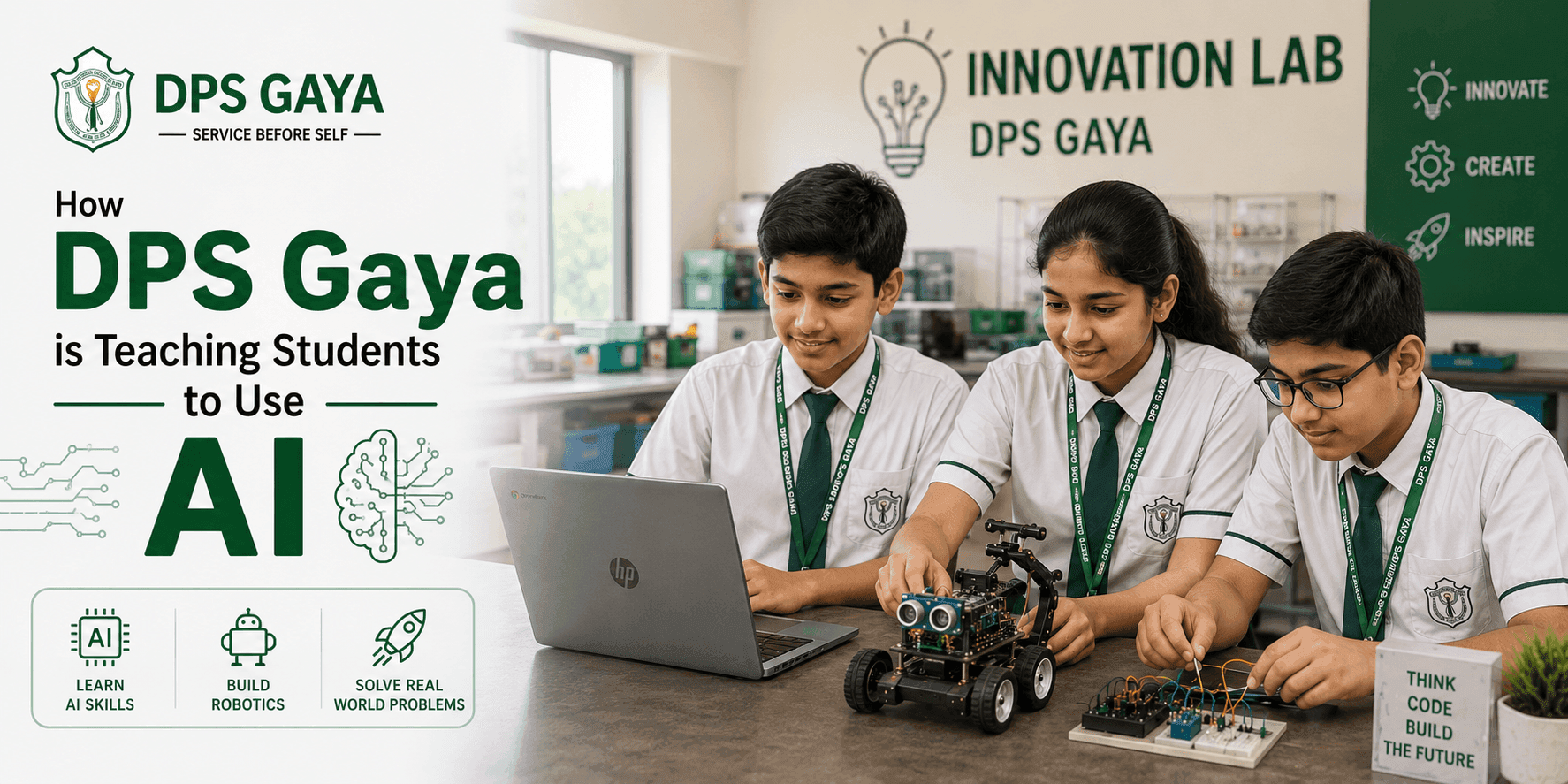
Coding and STEM Learning: Inside DPS Gaya's dedicated Robotics and Innovation Lab, students work with tools and environments where AI assists with debugging, logic checks, and design suggestions — teaching them to collaborate with technology, not depend on it.
Subject Understanding: For a student struggling with a concept in Mathematics or Science, AI-based learning support can offer explanations in different ways until the idea clicks — a kind of infinitely patient tutor available at any time.
This approach to technology-based learning in schools reflects a simple but powerful idea: the best tool is one you understand and control.
Encouraging Creativity and Innovation Through AI
Walk into DPS Gaya's Robotics and Innovation Lab and you will see something remarkable students not watching, but doing. Building robots. Programming drones. Designing solutions to real-world problems using LEGO robotics kits and hands-on hardware.
This is digital learning at DPS Gaya in its most vivid form. Students are not passive recipients of information about AI. They are makers. Innovators. They learn that a robot does not move unless they understand the logic behind the command. A drone does not fly straight unless the code is precise. These are lessons in critical thinking, perseverance, and creative problem-solving that no textbook alone can teach.
AI skills for school students go far beyond knowing what AI is. They include the ability to imagine a problem, design a solution, build a prototype, test it, fail, adjust, and try again. This cycle of innovation deeply embedded in DPS Gaya's approach — is exactly what future employers, universities, and the world will value most.
Whether it is building a working robot, designing an AI-powered quiz, or using machine learning concepts to analyse patterns in data, students at DPS Gaya are regularly encouraged to ask: Can I build something that solves this?
Teaching Responsible and Ethical Use of AI
This is perhaps the most important section of this blog — and the area where DPS Gaya's approach truly stands apart.
AI is a powerful tool, and like all powerful tools, it can be misused. The school takes this seriously. Teaching responsible AI use for students is not an optional conversation at DPS Gaya. It is woven into the fabric of how AI is introduced and practised at every level.
Students are taught to understand several core principles:
Fact-checking matters. AI tools can generate confident-sounding responses that are factually incorrect. Students learn never to accept an AI output at face value and always verify information from trusted sources.
Originality is non-negotiable. Copying an AI-generated paragraph and submitting it as your own work is not learning — it is borrowing someone else's thinking. Students at DPS Gaya are guided to use AI as a starting point, not a final answer.
Data privacy is real. What you share with an AI tool matters. Students learn to be thoughtful about personal information and digital footprints from an early age.
AI is a guide, not a shortcut. The student who understands a concept and uses AI to deepen that understanding will always outperform the student who used AI to avoid understanding it in the first place.
This ethical foundation ensures that AI education in Bihar schools, as practised at DPS Gaya, produces digitally responsible citizens — not just digitally skilled ones.
The Role of Teachers in AI-Based Learning
Technology is only as powerful as the human intelligence guiding it. At DPS Gaya, teachers are not sidelined by AI — they are central to it.
Every teacher at DPS Gaya undergoes training to remain current with developments in AI and digital learning. They do not just monitor screens. They ask the harder questions: Why did you choose this output? What would you change? What does this tell us that we didn't already know?
This teacher-guided model ensures that AI becomes a vehicle for deeper thinking rather than a way around it. When a student presents a project, the teacher's focus is not just on the final output it is on the process. Did the student think? Did they make choices? Did they understand what they built?
This is what separates a genuinely future-ready school from one that simply has gadgets in a room.
Preparing Students for a Future-Ready World
The future-ready education at Delhi Public School Gaya is built on a clear belief: the children of Gaya deserve every advantage that any student anywhere in the world receives.
The skills that AI education builds — computational thinking, creativity, digital literacy, ethical reasoning, problem-solving, collaboration — are precisely the skills that universities, companies, and the world at large will seek from the next generation. These are not soft extras. They are core competencies for the 21st century.
A student who graduates from DPS Gaya with genuine AI literacy enters higher education with confidence, enters the workforce with capability, and enters the world with a mindset that is curious, adaptable, and responsible.
Conclusion: The School That Prepares Students for Tomorrow, Today
AI education at DPS Gaya is not about following a trend. It is about a school that understands its responsibility deeply — to the children of Gaya, to the families who trust it, and to the Bihar that is quietly becoming a place where world-class education takes root.
If you are a parent looking for a school where your child will not just learn about AI but learn through it and with it — responsibly, creatively, and confidently — DPS Gaya is that school.
Because the best time to prepare a child for the future is right now.
Admissions Open for Academic Session 2026–27. Visit www.dpsgaya.com or call +91 8521092596 to know more.
Frequently Asked Questions
Yes. DPS Gaya integrates AI and robotics into its curriculum through three dedicated Robotics and Innovation Labs, with hands-on learning across classes using LEGO kits, drone programming, and real-world projects.
DPS Gaya introduces computational thinking and technology-based learning from the early years itself, building a strong foundation before formal AI and robotics training begins in later classes.
Teachers at DPS Gaya — trained through the school's dedicated Teacher Training Programme — emphasise fact-checking, originality, and critical thinking. Students are guided to use AI as a brainstorming and support tool, not a replacement for their own understanding and effort.
The school uses LEGO Robotics kits, drone-building hardware, coding environments, and AI-assisted learning platforms — all supervised by trained faculty within the school's Robotics and Innovation Lab. The school's IT infrastructure also supports digital learning across all classrooms.
AI-based learning tools improve understanding of concepts, strengthen logical thinking, and make personalised revision more effective — all of which contribute to stronger academic performance, as reflected in DPS Gaya's 99.3% First Division pass rate in Class XII (2025). Learn more about our academic approach here.
Get in Touch
Still have questions? Fill out the form below and our team will get back to you shortly.