



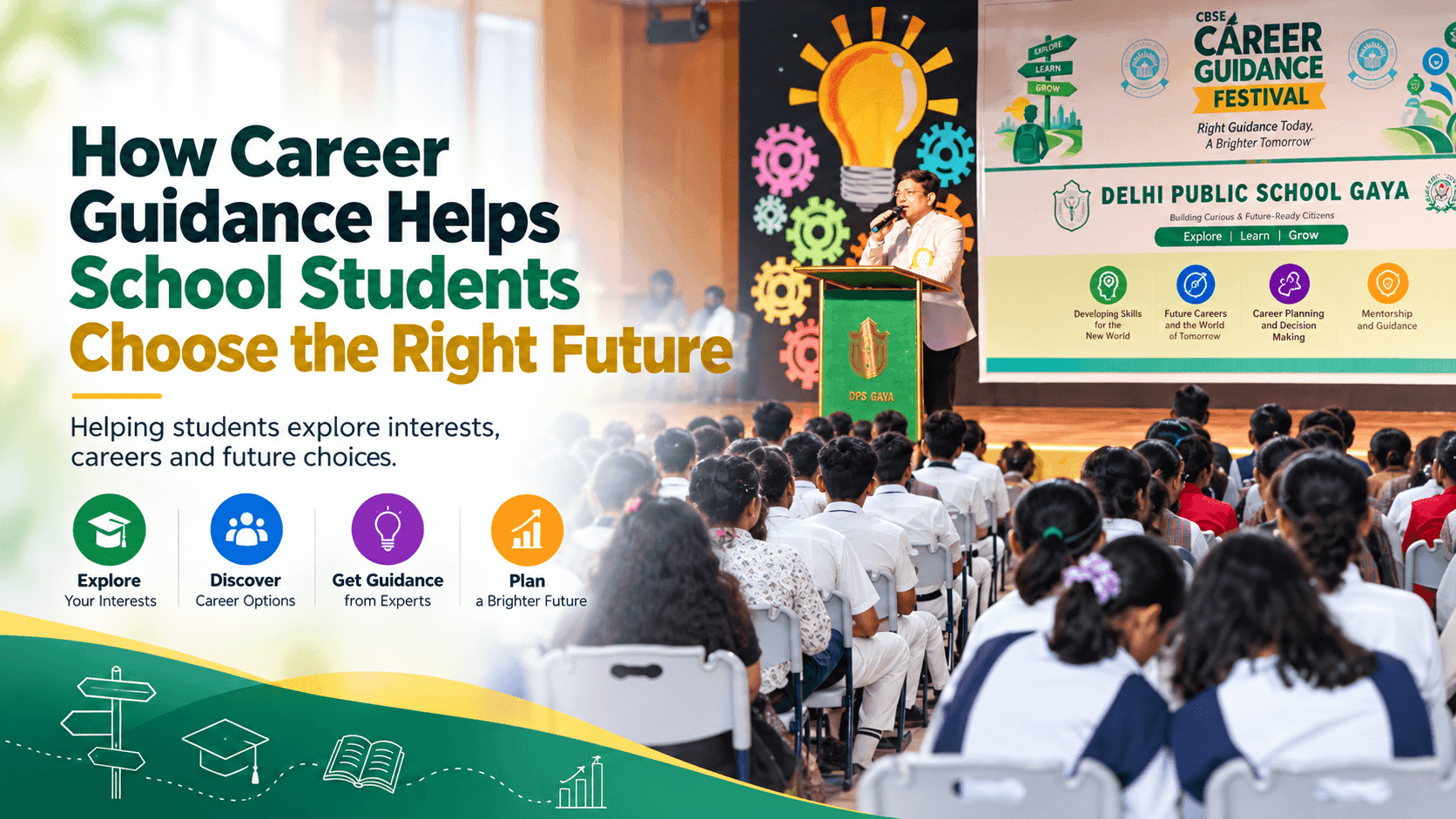
How Career Guidance Helps School Students Choose the Right Future
DPS Gaya Team
Verified Author
Riya is in Class 10, and her family keeps asking one question: Science, Commerce or Humanities? Her friends have already chosen Science. Her teachers say she writes well. Her parents are not sure what to advise.
Students today can choose from far more careers than earlier generations could. Picking subjects, streams and courses without proper guidance often leads to confusion and regret. Career guidance for school students offers a structured way to handle these decisions. It helps students look at their own abilities first, then match them with real academic and career options. Parents and teachers also get a clearer picture of how to support the child. This blog explains how it works, when to begin and who should be involved.
How Does Career Guidance Help School Students?
Career guidance helps students understand their interests, strengths, abilities, available academic options and suitable career paths. With this clarity, students make informed decisions instead of choosing based on pressure, trends or incomplete information. It turns a confusing choice into a planned process that students, parents and teachers can follow together.
Career guidance is the structured process of helping students understand their interests, abilities, academic options and potential career paths. It works in four stages:
Self-awareness: students identify what they enjoy and do well.
Career awareness: they learn what different careers involve.
Decision-making: they compare options using facts, not rumours.
Planning: they set steps for subjects, skills and higher education.
Why Is Career Guidance Important for School Students?
The importance of career guidance for students comes from one fact: they must make major choices with limited knowledge of how careers work. It gives them reliable information at the right time.
Many choices: Fields such as data science, design and sports management now sit beside medicine and engineering.
Too much information: Social media and advertisements offer plenty of advice, not all of it accurate.
Peer pressure: Students often follow friends or popular trends.
Family expectations: Parents mean well, but may know little about newer careers.
A changing job market: Job roles and required skills keep changing.
Early awareness gives students time. A Class 8 student who explores interests slowly can decide more calmly in Class 10.
Helps Students Understand Their Interests and Strengths
Career counselling for students begins with self-understanding. Counsellors and teachers look at interests, aptitude, personality, skills and academic performance together.
Marks alone should not decide a career. A student who scores well in Mathematics may enjoy design more than accounting. Another with average marks may have communication skills that suit journalism or digital communication.
An analytical student who enjoys patterns may explore data science, economics or engineering.
A creative student may look at design, architecture or media.
A student who enjoys communication may consider law, teaching or marketing.
A student curious about science or technology may explore research, medicine or cybersecurity.
These are possibilities, not labels. Every student has more than one strength.
Helps Students Explore Different Career Options
Career options for students now extend well beyond traditional choices. Counselling introduces both established and emerging fields.
Established paths include medicine, engineering, law, management and teaching. Growing areas include:
Artificial intelligence and data science
Cybersecurity
Environmental science
Sports management
Psychology
Digital communication
These examples are only illustrative. Students should judge each career by their aptitude, interests and long-term goals, not by popularity.
How Does Career Counselling Help Students Choose the Right Stream?
Career counselling helps students choose a stream by comparing their strengths and interests with suitable academic and career pathways. Stream selection after Class 10 is often the first major academic decision.
Science: Physics, Chemistry, Mathematics and Biology support engineering, medicine, research and technology.
Commerce: Accountancy, Economics and Business Studies support finance, management and entrepreneurship.
Humanities: History, Political Science, Psychology and languages support law, media, teaching and social research.
No stream is better than the others. A stream is right when it fits the student's aptitude, interests, target courses and goals. When students understand their interests and aptitude before choosing a stream, they are less likely to decide only because of peer pressure.
Trained career counsellors can help interpret interests, aptitude and abilities, and explain which courses need which subjects.
Reduces Career Confusion and Peer Pressure
Career guidance reduces confusion by replacing guesswork with information. Students commonly face these problems:
Choosing a career because friends have chosen it
Following social media trends without checking facts
Choosing only to meet family expectations
Deciding without knowing course requirements or entrance exams
A counsellor or teacher can ask students why they prefer an option. Once students see course content, effort needed and career outcomes, they feel more confident.
Helps Students Set Realistic Academic and Career Goals
Career planning for school students works best when goals are split into short-term and long-term steps.
Short-term goals may include improving a weak subject, practising communication skills or joining clubs to build skills.
Long-term goals may include preparing for entrance examinations, researching university requirements and exploring higher education options.
Families can explore academics at DPS Gaya to understand the subjects and curriculum the school offers.
At What Age Should Career Guidance Begin?
Career awareness can begin in middle school, while structured counselling becomes especially useful between Classes 9 and 12. No single age suits every student.
In Classes 6 to 8, students explore subjects, activities and professions. In Classes 9 and 10, they connect interests with subject and stream choices. In Classes 11 and 12, the focus shifts to courses, entrance examinations and higher education planning.
What Factors Should Students Consider Before Choosing a Career?
Students should consider their interests, aptitude, skills, personality and long-term goals, along with career opportunities and education requirements.
Interests: what they enjoy learning and doing
Aptitude: natural ability in specific areas
Academic strengths: subjects where they perform consistently
Personality: how they work with others and handle pressure
Skills: abilities already built or ready to develop
Career opportunities: demand, growth and variety of roles
Education required: courses, exams and duration
Work environment: office, field, lab, studio or remote
Long-term goals: where the student wants to be in ten years
Personal values: what matters, such as stability or creativity
Career decisions should weigh several factors together. One test score or one person's opinion is not enough. Assessments are useful, but they cannot predict a perfect career, so students, parents, teachers and counsellors should review results together.
What Role Do Parents Play in Career Planning?
Parents play a supportive role by listening, helping students research options and encouraging exploration without imposing their own choices.
Listen first: ask what the child enjoys before suggesting careers.
Know their strengths: notice what the child does well, inside and outside class.
Research together: look up courses, entrance exams and colleges as a team.
Avoid comparisons: every child has a different path.
Support realistic choices: discuss costs, effort and alternatives calmly.
What Role Do Schools Play in Career Guidance?
Schools play a role by giving students exposure, mentoring and structured support while they explore options. Career guidance in schools works best when teachers, counsellors and families share information.
A supportive school ecosystem can include:
Teachers who notice and encourage individual strengths
Mentoring and academic counselling
Competitions, clubs and leadership activities
Career awareness sessions and talks
Exposure to different subjects
Skill-building activities
Student counselling, where available
These experiences let students try things before choosing them. Families can read about student activities at DPS Gaya and the school facilities to understand what is available.
Supporting Students in Making Better Future Choices
At DPS Gaya, the broader goal of education is not limited to academic learning alone. A supportive school environment can help students build confidence, understand their abilities, develop skills and prepare for future academic and career decisions. Exposure to sports, activities and classroom learning gives students more chances to discover what they enjoy. Parents who want to know more can review admission information or contact DPS Gaya directly.
Conclusion
Choosing a career is a process, not a one-time decision. It starts with self-awareness, moves through exploration and becomes clearer as students make informed academic choices. Career guidance for school students supports each step by turning confusion into a plan.
Parents and teachers play an important part by listening, sharing information and respecting the student's own interests. Students, in turn, can ask questions, try new activities and stay open to learning about different paths. With patience and the right support, students gain confidence in their choices. Every child can find a path that suits their strengths, and the journey is worth taking one thoughtful step at a time.
Frequently Asked Questions
Career guidance for school students is a structured process that helps them understand their interests, abilities and academic options. It connects these strengths with suitable career paths, so students can choose subjects, streams and courses with clear information instead of guesswork.
Career counselling helps students compare their strengths with suitable academic and career pathways. It reduces confusion, limits the influence of peer pressure and helps students set realistic goals. Trained counsellors can also explain course requirements and higher education options clearly.
No single class is best. Light career awareness can begin in middle school. Structured counselling is most useful in Classes 9 and 10, before stream selection, and again in Classes 11 and 12, when students plan courses and entrance examinations.
Students can choose the right career after school by identifying their interests and strengths, researching career options, checking course requirements and speaking with teachers, parents and counsellors. Career decision-making improves when students review their plans regularly as they grow.
Yes. Career guidance helps students choose a stream after Class 10 by comparing their aptitude, interests and goals with the subjects and higher education routes each stream offers. No stream is superior; the right one is the stream that fits the student.
Get in Touch
Still have questions? Fill out the form below and our team will get back to you shortly.