


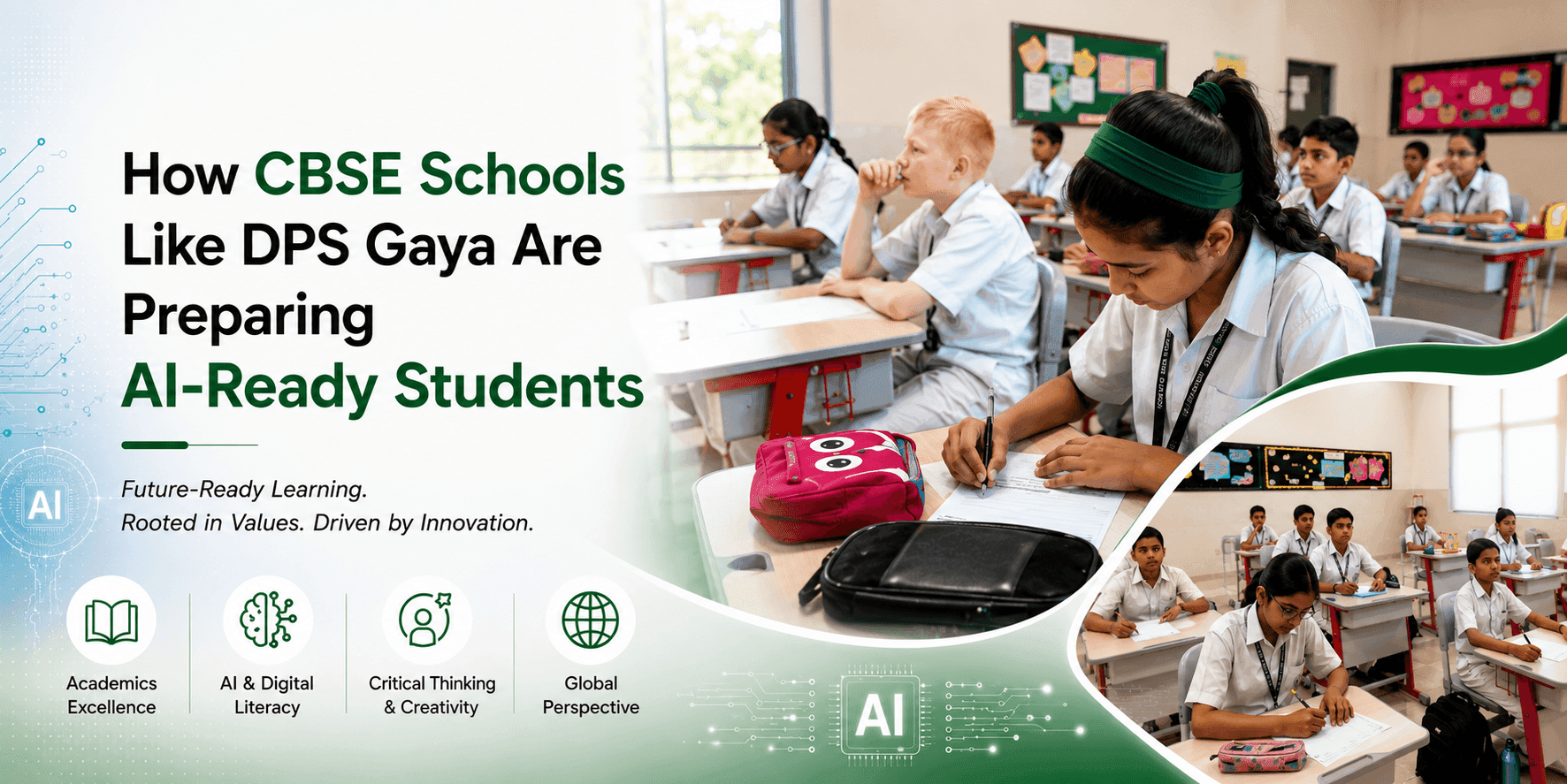
How CBSE Schools Like DPS Gaya Are Preparing AI-Ready Students
DPS Gaya Team
Verified Author
Artificial intelligence is quietly reshaping how people work, communicate, research and solve everyday problems. From voice assistants to recommendation systems, AI-assisted tools are becoming part of ordinary life across industries, and today's students will grow up surrounded by them. This is why AI education in CBSE schools is gaining attention among parents who want their children to be ready for what lies ahead.
Preparing AI-ready students does not mean replacing teachers or traditional subjects with machines. It means helping children use technology intelligently, creatively and responsibly, while still building strong foundations in reading, mathematics and human judgement. Delhi Public School Gaya, a CBSE-affiliated school in Gaya, Bihar, is one example of how a modern school approaches this balance through robotics, coding exposure and project-based learning.
How Are CBSE Schools Preparing Students for an AI-Driven Future?
CBSE schools are preparing students for an AI-driven future by combining AI awareness, coding, robotics, computational thinking, digital literacy, project-based learning and responsible technology use. Rather than treating artificial intelligence as a single subject, schools weave it into STEM activities, classroom projects and skill-building exercises. The goal is to help students think logically, solve real problems and use digital tools with judgement and responsibility.
Key Takeaways for Parents
AI education develops far more than technical skills; it builds curiosity, logic and creativity.
Computational thinking helps students break down problems and solve them systematically.
Robotics and coding activities encourage hands-on experimentation and teamwork.
Responsible AI education teaches students to verify information and use tools ethically.
A genuinely future-ready school combines trained teachers, practical activities and balanced technology use.
DPS Gaya's approach to robotics, AI exposure and digital learning supports students as academic and career expectations continue to change.
What Does It Mean to Be an AI-Ready Student?
AI-ready students are learners who understand how digital tools and artificial intelligence work, use them responsibly, analyse problems and apply technology creatively. Becoming AI-ready does not require advanced programming expertise, especially at school level.
Instead, it rests on a broader set of qualities: curiosity, digital literacy, logical reasoning, problem-solving, creativity, communication, collaboration, data awareness, ethical judgement and adaptability. These capabilities matter well beyond computer science. A student aiming for medicine, commerce, design, the humanities or entrepreneurship benefits equally from being able to think clearly, evaluate information and adapt to new tools. This is why AI literacy for students is increasingly treated as a foundational skill rather than a specialised one, alongside other digital skills for students that support learning across subjects.
Why AI Education Is Becoming Important in CBSE Schools
AI is no longer confined to research labs; it shapes everyday experiences through recommendation systems, voice assistants, search engines, generative AI tools, smart applications and automated systems that students already encounter. Because these technologies are so present in daily life, schools have a responsibility to help students understand, at an age-appropriate level, how such systems work and where their limitations lie.
This is precisely why AI education in CBSE schools is gaining momentum. At the same time, schools must balance this exposure with foundational subjects such as reading, writing, mathematics, communication and human judgement, since technology works best when it strengthens rather than replaces these basics.
How the CBSE Curriculum Supports Future-Ready Learning
Modern CBSE education increasingly encourages skill-based learning, experiential learning, project-based learning, computational thinking and interdisciplinary activities that connect classroom concepts to real situations. Schools can integrate artificial intelligence through classroom activities, skill modules, coding exercises, STEM projects and digital assignments rather than as an isolated topic.
This approach reflects a broader shift toward practical application of concepts, where a CBSE AI curriculum works alongside traditional academics instead of replacing them. Computational thinking and artificial intelligence, taught together, give students tools to approach problems methodically while still valuing depth in core subjects.
Seven Ways CBSE Schools Are Developing AI-Ready Students
1. Introducing AI Concepts at an Age-Appropriate Level
Younger students can begin with pattern recognition, sequencing and simple examples of how smart technology works, such as how a recommendation might be generated. Older students gradually explore data, algorithms, automation and the responsible use of AI, building understanding in manageable stages.
2. Building Computational Thinking Skills
Computational thinking involves decomposition, pattern recognition and logical, step-by-step problem-solving. Importantly, these computational thinking skills are useful even when students are not writing a single line of code, since they apply to mathematics, science projects and everyday decision-making alike.
3. Teaching Coding Through Practical Activities
Coding helps students convert an idea into a working solution. Through interactive stories, simple games, basic applications and small problem-solving tasks, coding and robotics for students become a way to practise logic and creativity together rather than abstract theory alone.
4. Using Robotics to Connect Theory With Practice
Robotics naturally combines science, mathematics, engineering, coding and teamwork. Students learn through trial, testing, correction and improvement, discovering that a working model rarely succeeds on the first attempt and that persistence is part of the process.
5. Encouraging STEM and Project-Based Learning
Multidisciplinary projects push students to apply concepts to practical problems. Examples include a smart irrigation model, a waste segregation concept, an energy-saving classroom design, simple weather data analysis or an automated traffic-light prototype, each combining STEM education with real-world thinking.
6. Teaching Responsible and Ethical AI Use
Students need to understand the risks of blindly trusting AI-generated information, including plagiarism, privacy violations, biased outputs and the temptation to let AI replace independent thinking. The responsible use of AI by students depends on verification, proper attribution, privacy awareness and sound human judgement, not just access to tools.
7. Developing Communication and Collaboration Skills
AI-driven careers still depend heavily on human capabilities. Group projects, presentations, debates and collaborative problem-solving remind students that technology should strengthen human skills such as teamwork and clear communication, not replace them.
How DPS Gaya Supports Future-Ready Education
A modern CBSE school prepares students through technology-supported classrooms, STEM-oriented activities, practical learning, digital resources, collaborative projects and consistent opportunities to explore innovation. At Delhi Public School Gaya, robotics and AI form part of this approach: the school operates a dedicated Robotics and Innovation Lab, including a LEGO Robotics Laboratory, where students get hands-on exposure to building and experimenting with robotics concepts alongside their regular academics.
This reflects a wider emphasis on future-ready education at DPS Gaya, where digital learning at DPS Gaya sits alongside strong classroom teaching rather than replacing it. As a technology-enabled school in Gaya, DPS Gaya aims to give students practical, age-appropriate exposure to robotics and AI concepts as part of a rounded CBSE education, in line with National Education Policy 2020 principles that encourage innovation alongside academics. Parents can read more about the school's philosophy on the DPS Gaya about us page.
AI Education Is More Than Learning to Use ChatGPT
AI education should not be limited to prompting a generative AI tool for answers. There is an important difference between simply consuming AI-generated content, understanding how AI systems actually work, evaluating the quality and reliability of AI output, applying AI thoughtfully to solve a real problem, and using AI responsibly with awareness of its limits.
The purpose of AI education is not to make students dependent on intelligent tools but to help them use those tools with knowledge, judgement and responsibility. Students should be encouraged to question results, cross-check information against reliable sources and continue developing their own ideas rather than outsourcing thinking entirely.
What Parents Should Look for in a Future-Ready CBSE School
Having computers or smart boards in classrooms alone does not make a school future-ready; technology needs to connect to meaningful learning outcomes. When evaluating a future-ready CBSE school, parents can look for:
Balanced use of technology alongside strong academic foundations
Practical STEM activities, not just theoretical instruction
Genuine coding or robotics exposure appropriate to each age group
Attentive teacher guidance rather than unsupervised screen time
Digital safety education and awareness of online risks
Opportunities for creativity, collaboration and leadership
A clear emphasis on ethical AI awareness and independent thinking
Among schools searching for the best CBSE school in Gaya or a future-ready school in Bihar, parents are best served by comparing how each school actually applies technology in daily learning rather than relying on labels alone. Those exploring options can review the DPS Gaya admissions procedure to understand the school's approach firsthand.
How AI-Ready Skills Can Support Students' Future Careers
AI-related skills extend well beyond software engineering, touching healthcare, business, finance, agriculture, media, design, education, research, manufacturing, entrepreneurship and public services. Students do not need to choose a career path while still at school; the real goal is developing adaptable AI skills for students and broader 21st-century skills for students that can support many different academic and professional directions later on.
Strong problem-solving skills for students, built through consistent practice, tend to transfer smoothly across whichever field a student eventually chooses.
Balancing AI With Human Values and Traditional Learning
Future-ready education depends on balance. Teacher guidance, reading and writing, mathematics, physical activity, art, social interaction, emotional intelligence, independent thinking, discipline and empathy remain just as essential as any digital skill. AI should support teachers and students, not replace meaningful human interaction in the classroom.
Age-appropriate technology use and sensible screen-time limits help ensure that digital learning strengthens, rather than crowds out, these broader human foundations.
Conclusion: Preparing Students for a Future They Will Help Create
AI education in CBSE schools is ultimately about developing adaptable, responsible, curious and capable learners, not producing instant AI experts. Coding, robotics and AI tools are valuable, but they form only part of a wider future-ready learning approach that still values strong academics and human judgement. DPS Gaya aims to combine solid academic foundations with practical, modern learning opportunities designed to help students face a changing world with confidence.
Parents who want to understand this approach in more detail are welcome to explore the DPS Gaya website, review its academic philosophy, and contact the school for admissions information to see how its learning environment supports future-ready students.
Frequently Asked Questions
AI education in CBSE schools involves age-appropriate exposure to AI concepts, computational thinking, coding, data awareness, digital literacy and ethical technology use. Rather than being a standalone subject, it is usually woven into STEM projects, classroom activities and skill-building exercises so students build understanding gradually and practically.
AI education helps students develop problem-solving ability, creativity, logical thinking, digital literacy and responsible technology usage. As AI tools become common in daily life and future workplaces, understanding how they work and where they fall short helps students engage with technology thoughtfully rather than passively.
No, advanced coding is not always necessary, especially for younger students. Children typically begin with logic, sequencing and simple problem-solving activities before gradually moving toward programming concepts, ensuring that computational thinking develops before technical complexity increases.
Robotics and coding support experimentation, teamwork, logical thinking, creativity and the practical application of science and mathematics. Students learn by building, testing and correcting their work, which builds resilience and problem-solving confidence useful well beyond any single subject.
Parents should look for strong academic foundations, practical STEM activities, responsible technology use, attentive teacher guidance, digital safety education and genuine opportunities for creativity and collaboration. Technology infrastructure alone is not a reliable indicator without meaningful classroom application.
DPS Gaya combines classroom academics with practical robotics and AI exposure through its dedicated Robotics and Innovation Lab, alongside STEM activities, digital learning resources and collaborative projects, reflecting a broader effort to build innovation and problem-solving skills alongside strong CBSE academics.
Get in Touch
Still have questions? Fill out the form below and our team will get back to you shortly.